Boeing must fix refueling tanker before Air Force buys more
Published in Business News
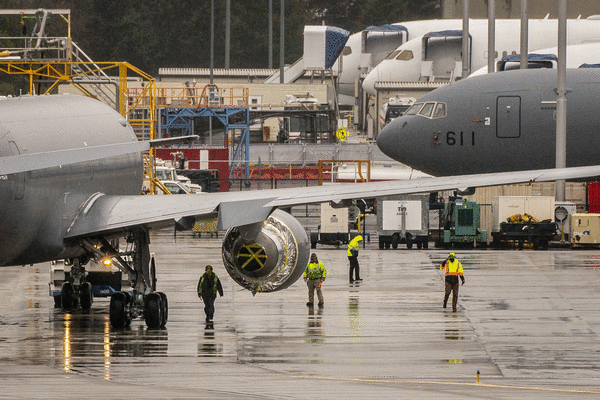
The Boeing Co. needs to fix a lingering defect with its aerial refueling tankers before the U.S. Air Force buys dozens of pricier versions of an aircraft that’s crucial for long-range military missions, according to budget and service documents.
Before it places an order for 75 more expensive KC-46 Pegasus tankers, the Air Force wants Boeing to fix problems with the planes’s so-called Remote Vision System, which limits its full capabilities because of “poor image quality and lack of depth perception under specific lighting conditions” that can “make the receiver aircraft difficult to see.”
Tankers like the KC-46 allow military planners to refuel other aircraft in mid-air, significantly extending the range of warplanes and other aircraft, including Air Force One.
“I think the good news is that we believe that we’ve fixed and have tested” the new version, Air Force Secretary Troy Meink told the Senate defense appropriations subcommittee on Tuesday.
Boeing was supposed to deliver an improved version of the aircraft in 2023, but that deadline has slipped to 2028 after several delays, the Air Force said in a statement to Bloomberg. In the meantime, safety restrictions to mitigate the concerns around the current remote vision system “require significant workarounds and advanced training,” it said.
Still, Air Force Chief of Staff General Kenneth Wilsbach told the same Senate panel that despite its limitations the aircraft “is performing magnificently” in the current war against Iran, even though “we know the current vision system isn’t what we ordered.”
The Air Force “continues to work with Boeing to resolve” all defects and has told Boeing that awarding a contract for additional jets is contingent “upon resolution of outstanding” issues, the service said. The purchase of 75 new aircraft would be on top of 183 tankers already purchased.
Boeing said in a statement “we’ve made a lot of progress demonstrating the system’s maturity and reliability” and the company has “completed the initial phase of flight testing that keeps us on a path toward certification.”
New versions of the tanker cost at least $334 million apiece instead of the current average $235 million, or roughly 42% more, according to Air Force budget documents. Boeing declined to comment on the reason for the increase.
But Lieutenant General David Tabor, the Air Force’s deputy chief of staff for plans and programs, told a Senate Armed Services Committee panel on May 12 that he believed “Boeing took those at a loss” and that “they would tell you the same thing — that if they were selling them at what they needed to, it would be significantly higher.”
Boeing continues to be fully responsible for costs to develop, test, certify, and produce the new design. The cost of improvements to the vision system are included in over $9 billion in charges taken on the tanker program in total, including $565 million this year.
©2026 Bloomberg L.P. Visit bloomberg.com. Distributed by Tribune Content Agency, LLC.










Comments