California's e-bike laws and restrictions: A guide on what to know
Published in News & Features
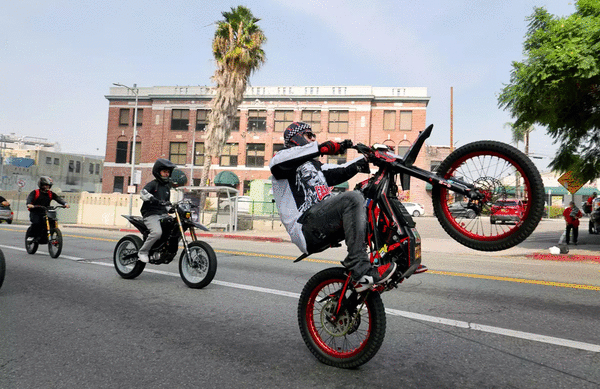
LOS ANGELES — It might whir like an e-bike and look like an e-bike, but that electric cycle sitting in the garage might not technically be an e-bike, or even be street legal, in California.
E-bikes have zoomed into popularity across the country, especially among kids and teens, and that surge has been met with a wide array of models with different specifications and abilities.
But according to law enforcement officials who have worked on cases involving e-bikes, many of the models being gifted to kids and teens that are bought from brick and mortar and online retailers are more akin to motorcycles than bicycles, and can reach dangerous speeds in seconds.
"Sometimes, what looks like an e-bike or is marketed as an e-bike is not a bike at all," said state Atty. Gen. Rob Bonta in a consumer warning about e-bikes in April. "If your or your teen's electric two-wheeled vehicle goes too fast, it might be a motorcycle or moped."
Police departments are also trying to educate the public before issuing citations or towing an illegal bike, but officials said it's a challenge.
"We're educating the public on what these terms are, what they mean, and what to look for," said Los Angeles police officer Brandon Pon of the West Traffic Division. "Most of these collisions, for the large part, they're likely preventable."
It's not just an issue of terminology; the consequences of a parent handing over what they think is an e-bike but with the capacity of a motorcycle to an inexperienced teenage rider can be disastrous, he said.
Here are some suggestions on what to look out for.
What doesn't qualify as an e-bike?
An electric two-wheeled vehicle with an electric motor is not considered an e-bike, cannot be ridden by anyone without a motorcycle license and requires vehicle registration with the DMV if it has any one of these specifications:
•It does not have operable pedals
•It has a motor stronger than 750 watts of power
•It provides pedal assistance beyond 28 mph
•It has a throttle that reaches speeds beyond 20 mph
What are the classes of e-bikes?
Electric cycles in California are also divided into three classes, depending on features and speeds, according to the California Department of Justice. All must be labeled according to their class:
•Class 1 — Known as low-speed pedal-assisted e-bikes, provide power when they are manually pedaled by the rider up until they reach a speed of 20 mph. Can be ridden by all ages.
•Class 2 — Known as low-speed throttle-assisted e-bikes, they have pedals, but can be powered solely from a throttle up to speeds of 20 mph. Can be ridden by all ages.
•Class 3— Known as pedal-assisted electric bicycles, provide electric power when they are manually pedaled by the rider, but can reach speeds of up to 28 mph with the help of the motor. They can be ridden only by people who are at least 16 years old, and wearing a helmet.
Are there other legal guidelines to consider?
All bikes must be properly labeled by retailers, and law enforcement is encouraging parents to look at what kind they buy, or have purchased, for their kids.
"Parents in general didn't know what the differences are between a Class 2 or Class 3," said Sgt. Gerard McCann of the Orange County Sheriff's Department. "That's part of the problem."
Law enforcement officials also point out that any type of modification to e-bikes might not just be dangerous, but can also transform the e-bike into a motorcycle or moped under California law.
Such modifications, like changing an e-bike's wheels, changing its motor or battery, or modifying its control panel to tweak speed controls and limits, might be considered a crime if the rider lacks a DMV license, according to the California attorney general.
Local cities, counties and school districts may also have implemented their own, additional laws and rules regarding the use of e-bikes in their area.
©2026 Los Angeles Times. Visit at latimes.com. Distributed by Tribune Content Agency, LLC.






Comments