Chicago schools engineer invents a device to lower lead levels in drinking fountains. But can it scale for a citywide crisis?
Published in Lifestyles


CHICAGO -- Late at night in 2016, Michael Ramos sat hunched over his dining room table in his suburban Harwood Heights condominium, assembling valves and motor parts he’d picked up from local electronics shops.
By day, he worked as a building engineer at Von Steuben Metropolitan Science Center high school in Chicago. By night, he tried to solve a problem he feared was putting students, and his own children, at risk: toxic lead in drinking water.
Ramos attended evening classes to become a home inspector and spent months tinkering on a palm-sized invention he believed could solve the lead contamination of the school’s water fountains. Several had tested above the Illinois Department of Public Health’s 5 parts per billion threshold, according to Chicago Public Schools.
Today, dozens of his devices have been installed in city and suburban schools, as well as in residences, but the city’s lead contamination problem is huge.
“Families and children are being exposed every day, and they don’t even know it because you can’t see it, you can’t smell it, you can’t taste it,” said Ramos, who has three children. “But it’s there.”
Chicago has the most lead lines in the nation, an infrastructure challenge that will take decades to address. In buildings and homes constructed before 1986, the year lead pipes were banned, contamination remains an invisible risk, including inside many of Chicago’s public schools.
Children are especially vulnerable to lead exposure, which can harm early brain development and lead to lifelong cognitive and behavioral issues. There is no safe level of lead exposure, according to the Centers for Disease Control and Prevention, and recent studies have found at least two-thirds of children under the age of 6 have been exposed to lead-contaminated water in Chicago.
For Ramos, he said he hadn’t paid much attention to Chicago’s water issue until the crisis in Flint, Michigan.
“(Flint) opened up the nation to the idea that we do have major water quality issues,” Ramos said. “As a father, I’m like, ‘Wow, well now you have my full attention.’”
In 2014, the city of Flint switched its water supply from Lake Huron to the Flint River to save money, causing distribution pipes to corrode and leach lead and other contaminants into municipal drinking water. Two years later, a state of emergency was declared, and Flint residents were told not to drink their tap water — but the damage was already done. Roughly one-quarter of children in Flint have tested for elevated levels of lead since the crisis, according to a 2022 Cornell University report.
For Ramos’ future business partner, Isidro Hurtado, the crisis hit close to home. His 8-year-old son was living with the boy’s mother just 5 miles from Flint in 2016.
“I remember going through that as a parent thinking, ‘Has my kid been drinking this water the whole time?’” Hurtado said.
After Flint, Chicago began widespread lead testing in public schools, revealing elevated levels across the system. But Ramos wasn’t willing to wait for a long-term fix.
“(Lead contamination is) happening in my house, it’s happening in my schools,” Ramos said.
“I see these babies, these little kids come from outside, from recess, and they go straight to one of these drinking fountains,” he added. “It’s just tough to watch.”
Replacing lead service lines can take years and thousands of dollars. Ramos wanted to find an immediate solution for his family and the thousands of schoolchildren he serves.
His idea was simple: Keep water moving.
When water sits idle in aging pipes, he explained, the protective orthophosphate layer that prevents corrosion begins to break down after several hours. That leaves stagnant water in direct contact with lead and other metals.
“We have an aging infrastructure,” Ramos said. “(The lead pipes) are rusting from the inside; the longer water sits in a pipe, the more likely it’s going to leach those components.”
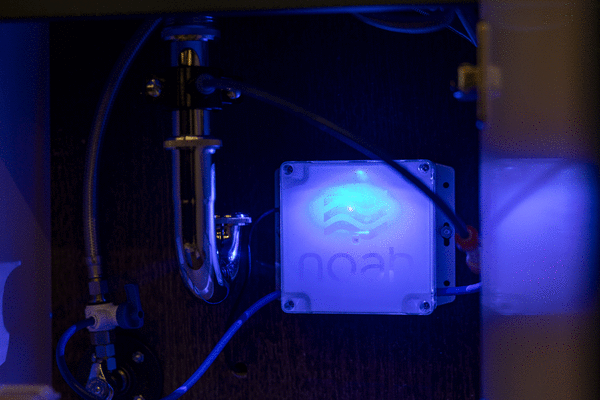
In 2023, Hurtado joined Ramos to create what would become the Noah system: a lead-removal device that doesn’t rely on costly, backlogged pipe replacements. Instead, the system automatically flushes drinking fountains every three hours, preventing water from sitting stagnant in lead-lined pipes.
“Nothing existed (like that) on the market,” he said. “So I’m like, ‘You know what? I’m going to try to build one myself.’”
The only reliable fix
As a CPS engineer for over three decades and after inspection training, Ramos said he felt uniquely positioned to take on this issue.
In 2016, CPS recommended manual flushing — running fountains for several minutes at the start of the week. Ramos worried about whether engineers could keep up with manually flushing over 40 drinking fountains in a given school.
“That’s really not solving anything,” Ramos said. “Especially for the students in athletics who start coming in at 6 a.m., they’re the first ones in the building. They’re in the gyms or in the swimming pools. They’re in the fitness rooms. They drink water right off the bat. So that means that water has been sitting stagnant overnight, and these kids are the first ones getting exposed.”
Ramos became convinced automation was the only reliable fix.
The Noah system — named after Ramos’ nephew, who has autism, a condition sometimes linked to elevated lead exposure — automatically flushes water every few hours, preventing stagnation without replacing pipes.
Auto-flushing devices are effective in turning water over in areas with water quality concerns, according to Kim Biggs, a public information officer with the Illinois Environmental Protection Agency.
In 2016, Ramos installed his first Noah device at Von Steuben. Ramos said lead levels that had previously exceeded 20 parts per billion dropped to nondetectable levels after installation — and have remained that way for nearly a decade. The U.S. Environmental Protection Agency limit is 15 parts per billion.
Hurtado said his wife, a teacher at Von Steuben, introduced him to Ramos.
“When I first learned what Michael was doing, I just wanted to be a part of it,” said Hurtado, who was working on creative development for another startup at the time. “Whatever you need me to do. We need a website, a logo. He had the name, but I wanted to help build the brand organization.”
Since then, Ramos has installed the system at Orr Academy High School and Belding Elementary School, suburban school districts in Elgin, Justice, Crete and Monee, and single-family residences.
Chicago Public Schools spokesperson Sylvia Barragan said in a statement that the technology has improved water quality.
She added auto-flushing has reduced the workload of manual weekly flushing and streamlined maintenance for school engineers in large facilities.
“The District expresses deep gratitude for the initiative shown by its Facilities Operations staff, taking particular pride in their ability to make a positive impact for the District,” Barragan said in the statement.
But Ramos and Hurtado are frustrated by the slow progress.
“Whenever we talk to people, they’re like, ‘Why isn’t this in every school?’” Hurtado said. “(CPS) is just not taking action.”
They said they think budget constraints are holding CPS back from adding more Noah systems.
Barragan said CPS is balancing its priorities for school buildings, which average 86 years old.
“While auto-flushing systems are helpful, they are not considered essential as the District’s manual flushing methods are working,” Barragan said. “CPS is committed to prioritizing critical needs, ensuring that funds are wisely allocated to maintain and improve its facilities.”
Ramos said replacing lead pipes and internal plumbing in a given school could run in the hundreds of thousands of dollars, while a Noah system in a large school facility like Von Steuben could cost around $20,000.
Across the city, fixing all the lead pipes in Chicago public schools would likely cost in the billions, Ramos estimated, while installing Noahs in these schools would cost around $10 million, without the need for major construction.
Each Noah device is priced just under $500, with an average annual water rate of $22 per unit in Illinois, which covers the cost of running water every three hours. Ramos said consistent flushing — whether done automatically or manually — is required to prevent corrosion.
“If stagnation is not addressed, we will see lead levels forever,” he said in a statement.
So far, Ramos said he’s donated all of his auto-flushing devices to CPS.
Meanwhile, a Milwaukee-based water solutions company called Zurn Elkay donated 30 similar auto-flushing fixtures to CPS, which have been installed in 18 schools located in underresourced communities, Barragan said. Rather than targeting an entire school, this donation went toward specific water fountains that exceeded state lead levels in multiple schools, she said.
Broader reach
Ramos has been a CPS engineer for over 30 years, allowing him to stay close to the city’s water quality issues. But he has also branched out to suburban school districts and residences, and in one case, was able to help when lead levels became a community crisis.
In mid-August 2019, the Illinois attorney general’s office and Will County state’s attorney’s office filed a lawsuit against Aqua Illinois, alleging the company failed to provide a safe water supply in University Park.
Testing in schools in the Crete-Monee School District, which enrolls students from University Park, revealed lead levels 90 times higher than the EPA limit.
Just last month, a federal judge approved a $12.5 million settlement in the class-action lawsuit between Aqua Illinois and University Park residents affected by the water contamination.
Keith McLean, buildings director for the school district, compared the situation to Flint after Aqua Illinois, the area’s main water supplier, switched from groundwater wells to the Kankakee River. Aqua then added a phosphate mix, allegedly removing a protective layer in the plumbing that allowed lead to leach into homes, schools and businesses.
The Crete-Monee school district installed Noah systems at six schools. As a result, drinking fountains that averaged over 58 parts per billion were lowered to undetectable levels of lead.
“This flushing system would have eliminated it altogether,” McLean said. “You’re flushing everything out that could have been in those pipes.”
In the four years since, McLean said some of his schools have replaced all of their water pipes to lower the lead levels, but he said he’d still consider adding more Noah units in University Park schools to avoid another crisis from other contaminants.
“Even without lead, the flushing is always going to be helpful,” McLean said.
He noted when schools are on break, custodians may not flush water fountains as regularly as needed.
“I can picture it in my head, the stagnation,” he said. “If you leave a glass of water on the counter for a week, you’ll see what it looks like. It doesn’t look clear anymore. I think that’s my thought process in consistently flushing. And if you can take that manual aspect out of it, it’s worth the money.”
Some homeowners have also embraced the technology.
Paul Brourman, the father of two teenagers and an early Noah adopter in 2018, said he didn’t want to wait years for city-led pipe replacement in his century-old Evanston home.
“I just didn’t want to keep playing around with having the lead in the house at all,” he said.
Brourman said he’s surprised more people haven’t bought into the flushing solution.
“If there is a longer-term solve, it would be shocking if people didn’t do something in the meantime to protect the kids, to provide clean drinking water, or the cleanest, best solution possible in the meantime,” Brourman said. “You wonder, what would it take to drive attention (to this issue) again?”
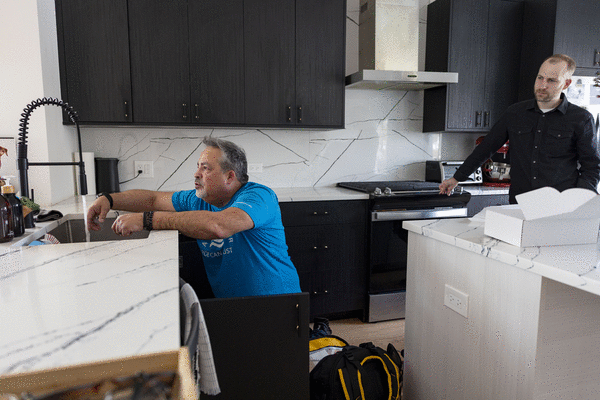
On a recent Sunday, Ramos and Hurtado were working at the Galewood home of Anthony and Paulina Argentine, who are expecting their first child.
“Having a newborn, it’s like the most sensitive point in your life,” Anthony Argentine said. “So we’re trying to have as clean of food, clean of water as possible.”
Getting pregnant motivated the couple to look into a cost-efficient option to protect their child from lead contamination.
“(Chicago) is projecting 20 years to fix this,” Anthony Argentine said. “After a while, you’re kind of like, ‘I think I just need to do this myself.’ And now there’s so much cool technology, so there are solutions. And when you find something this affordable, it’s kind of like the best thing.”
Business challenges
Despite success stories and an obvious need, Ramos said finding enough customers to build a stable business has been a challenge for a small startup without major investors.
He’s sent thousands of outreach emails to communities like Milwaukee and Elgin, hoping to raise awareness about interim solutions. Both cities share Chicago’s widespread lead contamination issue: Milwaukee has had to close multiple schools in recent years due to high rates of lead poisoning, while Elgin has the second-largest lead service lines outside Chicago.
But a growing number of investors are paying attention to water technologies in the Midwest. Chicago’s first Sustainable Water Tech Accelerator, a program backed by the National Science Foundation and operated jointly by Chicago-based hard-tech innovation center mHUB and the nonprofit Current, aims to build up the city’s “circular blue economy,” said Nina Dudnik, Current’s chief commercial officer.
Current hosted the Chicago Water Week, an annual citywide event in May that highlights water innovation and technology, including startups in its water tech accelerator.
Noah was one of seven water startups selected for the accelerator, each receiving $200,000 to get their businesses off the ground.
“Noah systems has really incredible quantitative data from their work with the Chicago Public Schools on the levels of lead in the water before and after using their technology,” said Dudnik. “They’ve really demonstrated just how dramatically they can reduce that.”
The science foundation awarded Current up to $45 million in late March to continue scaling its investments in water innovation.
“Ultimately for the city of Chicago and lots of other cities across the country, the goal is to replace the pipes, but in that interim, you need a solution so that our children are not exposed to lead-contaminated water,” Dudnik added.
Michael Sundermeier, mHUB accelerator’s platform and program manager, joined Noah as its chief executive officer in early May to scale the startup beyond the Chicago area.
Sundermeier has worked with over 200 startups as a venture capitalist, but he said he was waiting for the right one to join. Having experienced water quality concerns growing up in Chicago’s south suburbs, Sundermeier said he was drawn to Noah’s mission and wanted to help grow the product.
“In Chicago, we have this infrastructure of old lead pipes, so to be back in the school market, solving problems that students need is so important,” he said.
With the accelerator’s support, Ramos and Hurtado are now developing a new version of the device that includes an app so users can monitor a dashboard for schools with multiple Noah units.
For now, Ramos said their mission remains simple.
“Get the lead problem out of the equation,” he said. “Then maybe we can better understand what’s happening with our kids.”
©2026 Chicago Tribune. Visit at chicagotribune.com. Distributed by Tribune Content Agency, LLC.





















Comments