Inspired by piping plover enthusiasts, couple protects killdeer eggs at construction site
Published in Science & Technology News


CHICAGO -- For four years, Lockport, Illinois, residents Ray and Shelly Romolt have stared out their window at an empty lot, waiting for the day developers would transform it into a home for new neighbors.
They’ve been eager to watch construction commence, and have long pictured the moment a moving truck would deliver fresh faces to join them for bocce, book clubs or “driveway drinking” — three activities commonly practiced in their southwest suburban over-55 neighborhood.
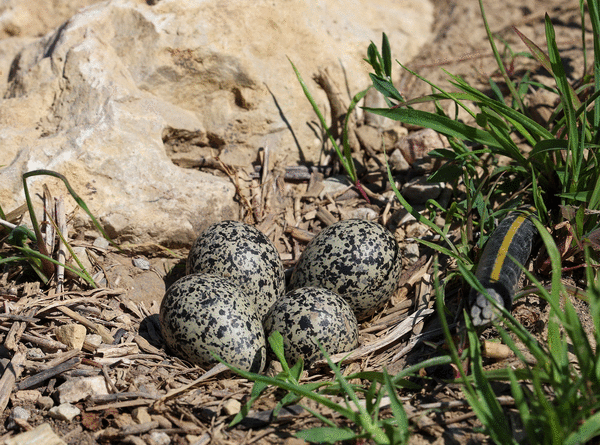
Normally, the couple would’ve been giddy after seeing a sold sign on the lot last month, and even more excited when mesh construction fencing began to go up two weeks ago. But now, after spotting four speckled eggs resting on the ground, they’re working to delay the process in an effort to keep a family of killdeer birds safe.
“We want you to stop, just for a month or so,” Shelly Romolt said her husband told an employee at the development’s model home. “And then, please, build away.”
According to Stephanie Beilke, the senior manager of conservation science at Audubon Great Lakes, killdeer are protected under the Migratory Bird Treaty Act, which dictates that no bird native to the U.S. can be hunted, killed or transported without prior authorization by the Department of Interior U.S. Fish and Wildlife Service.
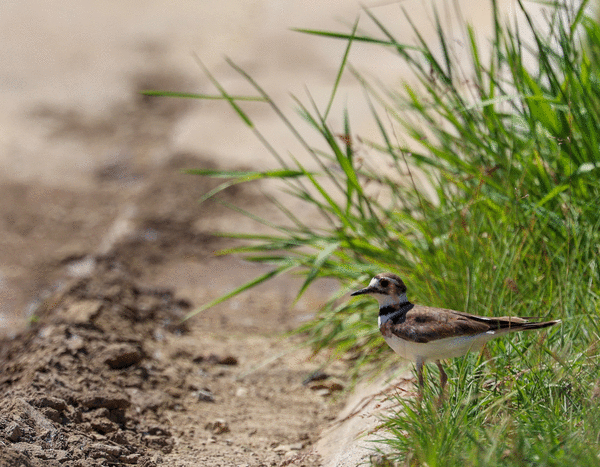
Beilke said killdeer are a type of shorebird considered close relatives to the endangered piping plovers best known in Chicago for their appearances on Montrose Beach. Having read about the connection between the two species online, the Romolts said protecting their neighborhood’s killdeer makes them feel like they’re playing a role in the Chicago’s yearslong piping plover craze.
“We’ve followed some of the plovers on Montrose Beach and how they’ve cordoned off where they’re nesting and people watch for the eggs to hatch,” Shelly Romolt said. “We’ve got our own little thing going on here, so we’re pretty excited about that.”
Though she’s seen killdeer around her neighborhood over the years, Shelly Romolt said she first suspected chicks were on the way when she spotted “some big shenanigans going on” between two adult birds in the neighborhood in late May.
“I don’t know anything about this biology, but three days later we had our first two eggs,” she said.
Since then, she and her husband have become somewhat of vigilante ornithologists, contacting everyone from the Illinois Department of Natural Resources to the corporate offices of national homebuilding agency D.R. Horton, the lot’s developers, about the situation. They learned killdeer have an incubation period of a little less than a month, and they intend to keep the eggs safe until then.
At first, Ray Romolt wasn’t sure the birds were federally protected, but said he convinced a construction crew who brought a small bulldozer to the property to slow their roll until they could learn more. The Romolts were impressed by the responsiveness of D.R. Horton’s corporate team, who they said put them in contact with the local site supervisor.
The couple said D.R. Horton’s team suggested they contact the Illinois Department of Natural Resources before they decided on any next steps. When Shelly Romolt called, she reached a Will County conservation police officer, who quickly followed up to confirm killdeer are federally protected and that construction crews could be cited if they chose to proceed without a permit.
Joshua Mooi, the northeast zone captain of Illinois’ Conservation Police, said Shelly Romolt’s call is the type of thing his team responds to regularly, assisting residents by walking them through the process of what they can and can’t do. He said people are often surprised to learn it’s not just endangered species like piping plovers that are federally protected, but all native birds, including those as common as robins or ducks.
Beilke, the Audubon conservation science director, said that even though many of these birds — including killdeer — are not endangered, that does not mean they aren’t at risk.
The International Union for Conservation of Nature, which labels species safety on a scale from “least concern” to “extinct,” upgraded the killdeer’s status to “near-threatened” in 2024. On its website, the IUCN notes the killdeer population is high now, but is expected to decline across the next three generations by more than 20%.
Within a day of their exchange with the conservation police, the Romolts said the site supervisor came to the lot and placed caution tape and cones around the nesting site, assuring them the company would postpone their scheduled “dig date” until the birds had hatched. Attempts by the Tribune to reach D.R. Horton and its local site supervisor for comment were unsuccessful.
While they have no formal guarantee construction will be delayed, the couple said they trust the developers will stick to their word, joining them in their mission to keep the baby birds safe. If not, the Romolts told them they will stop at nothing to protect the eggs until they are expected to hatch sometime this month.
“I’m going to have to lay down in front of a bulldozer if I need to,” Ray Romolt said.
©2026 Chicago Tribune. Visit at chicagotribune.com. Distributed by Tribune Content Agency, LLC.






Comments