Abby McCloskey: US parents deserve time with their newborns
Published in Op Eds
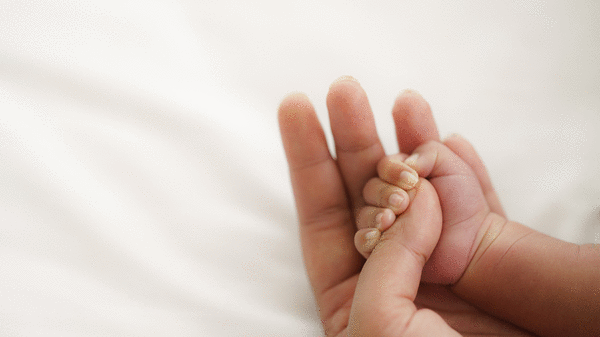
The private sector is cutting parental leave benefits. The U.S. fertility rate is at sub-replacement levels. Republicans in Congress seem rudderless in the face of affordability concerns. This is exactly the right time for a federal paid parental leave policy. Specifically, America needs a six-week baseline for all working parents. And yes, we can afford that.
Most parents of young children are in the workforce, including mothers, almost half of whom are now the primary household breadwinner. Yet 44% of workers lack any job protection after having a child, and only one in four have access to paid parental leave from their employer.
As a result, many women drop out of the labor force to care for children. Others return to work much before their bodies have healed or their children are suited to be outside of parental care.
An oft-cited study from the Department of Labor found that one-in-four women returned to work within two weeks of giving birth. As someone who has given birth three times, let me just say it plainly: That’s borderline barbaric. For the parents. And for the baby.
Which is why the rest of the developed world has implemented paid parental leave, averaging 18 weeks for mothers. Many also offer paid leave for fathers. The results have been overwhelmingly positive and include lower rates of neonatal fatalities, lower rates of postpartum depression, higher rates of breastfeeding, greater financial stability and even a slight positive bump on fertility.
But in the U.S., no such baseline of support exists for new parents. Why? Blame our politics, for a start. American progressives have long called for mandatory paid leave, but of a wide-ranging and rambling sort, including vacation weeks, sick days, caregiving and medical leave. This would create an employer’s nightmare of potentially overlapping, unpredictable and repeating absences and a government problem of verification and fraud concerns.
The call of American conservatives has, by and large, been to let the private sector handle it. And while private sector coverage has indeed grown, it remains the exception and on the chopping block. Deloitte and Zoom recently made headlines for slashing their generous paid parental leave plans. The ability of a parent and child to bond after birth should not be subject to fluctuating labor market conditions.
Nor should it be subject to the state a child is born in or whether that parent is a public employee. Yet that, too, is the case. Only 14 states and DC have implemented paid leave programs for new parents. President Donald Trump instituted paid parental leave for federal employees in his first term, and many states have followed suit, providing paid parental leave to state employees. But even this coverage tends to exclude public jobs like teachers.
To its credit, this Congress has nibbled around the edges of the problem. They expanded tax credits for companies that provide paid leave programs, but uptake has been de minimis. There also have been bipartisan, bicameral working groups that developed plans to provide administrative funding for states to set up paid parental leave programs of their own. But my sense is that the administrative cost offset won’t be enough to cover the cost to states of providing the benefit, especially as state budgets face a squeeze from the Trump administration’s Medicaid cuts.
There are more direct ways to provide paid leave nationwide. Specifically, we need a federal baseline of a six-week paid leave policy for new parents. Six weeks is the absolute earliest that most child-care centers accept infants. It’s also when women get their postpartum wellness check. Companies or states could layer on a more generous policy should they so choose, but a six-week leave would provide a floor that no working parent would fall below.
Ideally, this leave would come with job protection and close to full wage replacement, especially for low- and middle-income workers. It would appeal to conservatives because it has a built-in marriage bonus, as married couples could take the leave back-to-back. And it would appeal to liberals because both parents would have access to an equal amount of leave. It’s also the benefit parents say they need most in the first year of a child’s life, more than any “baby bonus” or other cash payment, as I wrote in a recent paper for the Bipartisan Policy Center.
A six-week paid leave need not be overly costly. I was part of the AEI-Brookings Working Group in 2017-2018 that estimated the cost of a more generous eight-week policy at roughly $8 billion a year. For perspective, that’s a fraction of the $128 billion spent on the Child Tax Credit last year, recent expansions of which have been unfunded. It’s also a drop in the bucket compared to our ballooning spending on old-age entitlements that are crowding out investment in the young. Ideally, a budget reform package could help to modernize benefits and smooth this generational inequity.
And although nothing pays for itself in real time, a recent study found that every $1,000 investment in paid parental leave would generate $7,275 to $29,406 in social benefits.
The White House knows this. The first Trump Administration proposed a six-week paid maternity leave policy in their White House budget. It could finish the job this term.
American families would be better off for it.
_____
This column reflects the personal views of the author and does not necessarily reflect the opinion of the editorial board or Bloomberg LP and its owners.
Abby McCloskey is a columnist, podcast host, and consultant. She directed domestic policy on two presidential campaigns and was director of economic policy at the American Enterprise Institute.
_____
©2026 Bloomberg L.P. Visit bloomberg.com/opinion. Distributed by Tribune Content Agency, LLC.



















































Comments