Commentary: Tom Steyer's stumble shows the perils facing self-funded candidates
Published in Op Eds
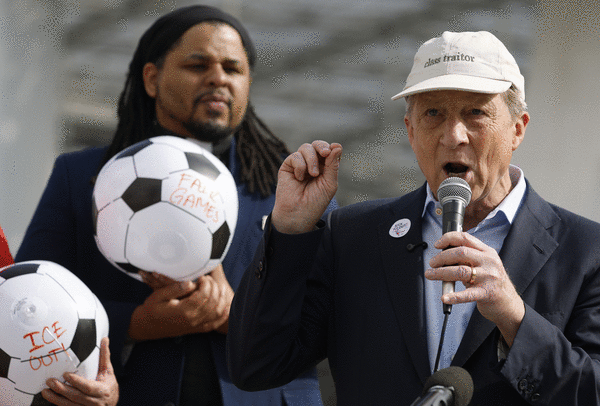
With Tom Steyer all but eliminated from California’s top-two gubernatorial runoff in November, he joins a long conga line of beaucoup-bucks, self-funding candidates who tried to buy their way into elected office in our state and failed miserably.
This includes Carly Fiorina, Meg Whitman, Al Checchi and Michael Huffington. Whitman, a former CEO of eBay, was the fifth-wealthiest woman in California when she became the last rich, first-time candidate to try to make the governorship a corporate-takeover target. She reached into her purse for a total of $144 million in the 2010 governor’s race, setting a record for the most ever spent on a statewide race in American history. For her trouble, she was demolished in the general election by Jerry Brown, 54-41. Steyer, for his part, made Whitman look like a piker, breaking all national records by finding $216 million in his spare-change drawer.
I had my own first-hand experience with one of these wealthy first-time candidates in the 1998 governor’s race, in which I ran then-Lt. Gov. Gray Davis’ successful campaign. Our chief opponent was Checchi, a multimillionaire owner of the now-defunct Northwest Airlines. In the primary, he spent $40 million trying to promote himself and tear down Davis, also at the time a national record for the most ever spent on a statewide campaign. In the end, after spending only $9 million on our own campaign, we beat Checchi 3 to 1 in the primary.
Truth to tell, I also ran the gubernatorial campaign in the 2006 Democratic primary of then state controller Steve Westly, who as an executive of eBay (sound familiar?) had received a $275 million payout when he left the firm. I also years ago happen to have managed a U.S. Senate race in Illinois on behalf of a failed self-funding millionaire candidate.
Based on these personal, up-close experiences, I have formed some conclusions about why this type of candidate has almost always fails to connect with voters.
First, although voters are oftentimes impressed at first glance with someone who has made a killing in our capitalistic, free-enterprise system (a bit of envy, perhaps, over these American success stories?), I have seen in a multitude of focus groups how they then start to question how such a candidate could possibly identify or empathize with the financial struggles of the average voter. Often heard were musings like, “If a candidate has tens of millions of dollars lying around to throw into a campaign where success is not guaranteed, how can he or she possibly understand the daily financial pressures in my family’s life?” In other words, the very wealth being used to finance the campaign becomes a stumbling block for many voters.
Second, with wealthy first-time candidates, voters start to question why a candidate seeking high public office didn’t start at a lower level, and how they can be asking for their vote for governor or Senate having never served a day in public service. With Checchi in 1998, who had blanketed the airwaves for months à la Steyer, voters would ask: “Who is this guy, anyway? I’ve never heard of him, and now he wants me to vote for him for governor?”
In some cases, these kinds of candidates have not even bothered to vote, let alone hold public office. In Checchi’s case, our research found that he hadn’t voted the last time California elected a governor, in 1994, in either the primary or general election. Voters in focus groups found that unbelievable and disqualifying for a gubernatorial candidate just four years later. Likewise, Whitman in the 2010 governor’s race was discovered to have not cast a vote in the last gubernatorial election for the man she was seeking to replace, Arnold Schwarzenegger. A Sacramento Bee investigative piece also found there was no evidence Whitman had ever registered to vote in some of the six states in which she had lived. This factor was galling to voters in focus groups: “You mean this candidate is asking for my vote and doesn’t bother to vote themselves?”
Third, it sounds facetious to suggest a candidate can have too much money in a campaign, but it turns out to be true. Like Steyer, Checchi went on the air with ads early in the campaign and never went dark all the way to election eve. Because they have no monetary restraints, these kinds of candidates think they can just blow every other candidate away with zillions of TV spots. But ultimately, they wear out their welcome with voters, who become weary and then annoyed with seeing their omnipresent ads on TV. In Checchi’s case, when we would show his ads to focus groups, we would hear things like: “Oh, no, not him again! I’m so sick and tired of seeing his mug on TV every three minutes, I want to throw something at the screen.” In campaign advertising, there actually can be too much of a good thing.
So, Tom Steyer, welcome to the hall of infamy of filthy-rich flops. You, along with the other many inductees, now understand that voters, consciously or unknowingly, subscribe to that famous F. Scott Fitzgerald line that says the very rich “are different from you and me.”
____
Garry South is a Democratic strategist who has managed four campaigns for governor of California and two for lieutenant governor.
©2026 Los Angeles Times. Visit at latimes.com. Distributed by Tribune Content Agency, LLC.









Comments