Commentary: The Trump administration succeeded in Armenia where others fell short
Published in Op Eds
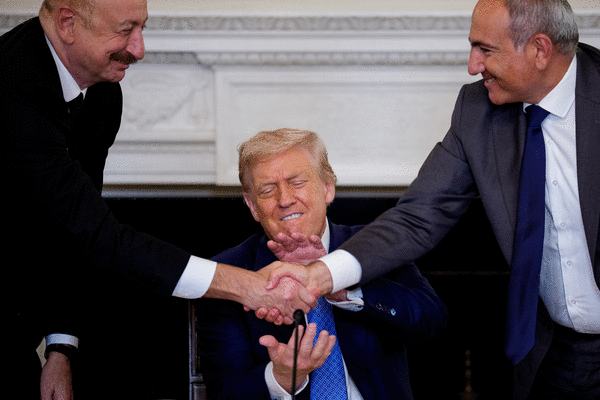
The U.S. and Europe tried unsuccessfully for 35 years to end the conflict between Armenia and Azerbaijan. Moscow also failed, sending “peacekeepers” after Azerbaijan’s attacks on Nagorno-Karabakh in 2020; these forces idly watched when Azerbaijan took the entire region and drove out 110,000 ethnic Armenians in 2023.
President Joe Biden’s measured response to the exodus continued the stale “balanced” regional policy that could not overcome decades of hostility. But the dynamic changed under President Donald Trump.
Shortly after taking office for the second time, Trump’s administration decided to quietly but directly engage the Armenian prime minister and the Azerbaijani president to see if a deal could be done in the South Caucasus — a move prompted in part by the powerful American evangelical community that supported Armenia as the world’s first Christian nation. At a summit at the White House last August, both parties committed to the inviolability of international borders, the inadmissibility of the use of force and the opening of regional transportation links.
The Trump administration’s admirably swift progress in a famously difficult part of the world can be credited to favorable conditions combined with innovative approaches not attempted by previous administrations. When Trump assumed office in January 2025, Armenia and Azerbaijan were both seeking to restrain Russian influence in the region. Both saw benefits to working with each other to resolve issues, which was itself a new and positive step. While the work of the Biden administration and European diplomacy set a foundation, their adherence to traditional approaches was not enough to overcome the power differential between the two countries and a peace deal was elusive.
The Trump administration’s frequent high-level engagement with the Armenian prime minister, starting with a White House meeting with Vice President JD Vance less than three weeks after the inauguration, have bolstered Armenia’s position in the talks and incentivized the Azerbaijani president’s more constructive approach.
The element that set the Trump administration’s diplomacy apart was its proposal to develop a U.S.-Armenia project called the Trump Route for International Peace and Prosperity, an east-west link between Central Asia and Western Europe that will benefit every country along its path by creating or restoring rail, fiber optic and gas pipeline connections.
Direct U.S. involvement in the proposal — branded with Trump’s name — provided each country enough assurance to reach agreement on an issue that had long been a point of contention. Because of U.S. commitments, Armenia expects to control the infrastructure and Azerbaijan expects to retain access.
Once construction is underway the route will provide Armenia with a de facto security guarantee in its most vulnerable region, increasing regional stability and ensuring sovereignty, territorial integrity and jurisdiction — something no other outside negotiator has managed to achieve.
While each conflict is unique, some lessons from Trump’s success in the Caucasus could apply elsewhere. Trump’s public support for the Armenian leader and on-the-ground presence reduced the power imbalance and incentivized Azerbaijan to come to the table.
In Ukraine, a larger and better armed autocrat also threatens a smaller, weaker democracy. Trump-branded projects there could help deter Russian attacks on key infrastructure; the Trump-initiated U.S.-Ukraine Reconstruction Investment Fund could be a mechanism to develop these joint ventures. Refocusing diplomatic attention from Moscow to Kyiv could better balance the power differential and show Russian leader Vladimir Putin that he stands to lose by obstructing peace.
Positive momentum in Armenia continues. Late last month, U.S. Secretary of State Marco Rubio visited the Armenian capital to keep the commitments moving forward. Sunday’s parliamentary elections affirmed the Armenian public’s support of U.S. engagement and its government’s approach. It also demonstrated that Armenia, like other former Soviet states before it, have tired of toxic Russian “partnership.”
More needs to be done to secure lasting stability, including delimitation of the Armenia-Azerbaijan border, signing and ratification of the peace agreement, Turkish action to open its border with Armenia, Azerbaijani release of Armenian political prisoners and the actual construction of the promised route.
Despite the many other global challenges requiring the attention of the Trump administration, including the U.S.-Israeli-led conflict with neighboring Iran, we may now be seeing the best opportunity in decades for lasting peace in the South Caucasus. Sustained focus and adherence to the principles of last summer’s White House summit offer a promising path forward that should be replicated elsewhere.
____
Kristina A. Kvien, a career diplomat who was the U.S. ambassador to Armenia from 2023 to 2026, is the president and chief executive of the Pacific Council on International Policy.
©2026 Los Angeles Times. Visit at latimes.com. Distributed by Tribune Content Agency, LLC.




















































Comments