Commentary: What Andy Rooney might say about the downfall of '60 Minutes'
Published in Op Eds
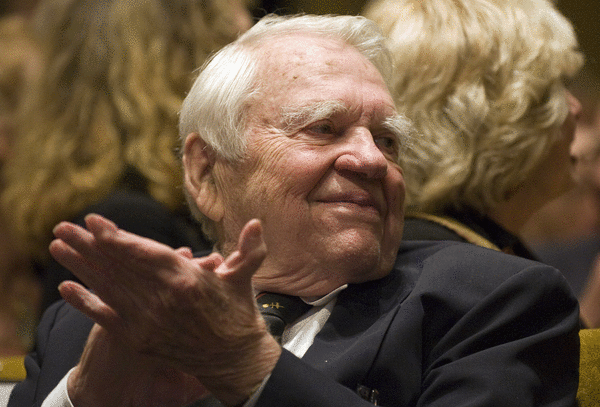
The turmoil engulfing CBS News and “60 Minutes” has left me wondering what my grandfather Andy Rooney would make of it all.
Rooney died in 2011 after more than three decades as a fixture of the newsmagazine, and with each passing year I find myself wishing we could hear one more of his droll observations about the state of the world. He had a gift for taking something maddening, absurd or just confusing and reducing it to a simple truth. Unfortunately, there is nothing particularly funny about what is happening to American journalism today.
The recent upheaval at CBS illustrates a troubling trend. Following Paramount’s merger with Skydance in 2024, major changes have swept through the network, including the leadership and editorial structure of “60 Minutes,” long regarded as one of the most respected news programs in American television.
The shakeup has triggered concerns among journalists and former staff about the future editorial independence of the network and whether corporate and political pressures are beginning to shape newsroom decisions.
At the heart of the concern is a question that should matter to everyone, regardless of politics: Who controls the news?
For generations, American journalism operated with an understanding that owners owned the company, but journalists decided what stories were covered. That firewall was never perfect, but it existed. Increasingly, it appears to be eroding.
What is happening at CBS is not an isolated incident. It is part of a broader assault on independent journalism.
President Donald Trump has spent years attacking the press, branding journalists “the enemy of the people” and dismissing unfavorable reporting as “fake news.” But the rhetoric has often been accompanied by action. His administration has sued major news organizations, jailed journalists, restricted the Pentagon press corps, threatened to revoke broadcast licenses, used the Federal Communications Commission to investigate newsrooms, triggered the firing of late-night talk show hosts, gutted the Voice of America and worked to weaken independent journalism wherever it exists. The pattern is difficult to ignore: discredit the press, intimidate the press and ultimately control the press.
I witnessed this firsthand. I spent nearly a decade working at NPR before being laid off after Congress voted to eliminate federal funding for public broadcasting after years of political attacks on the institution. Regardless of where one stands politically, this effort demonstrated how vulnerable independent journalism can become when it is portrayed as an enemy rather than a public service.
My grandfather understood that vulnerability.
Most Americans remember Andy Rooney for his closing commentaries on “60 Minutes,” where he offered humorous observations about everything from junk drawers to doorknobs. But before television made him famous, he was a reporter and war correspondent. His first journalism job was with Stars and Stripes, the military newspaper he served during World War II.
For more than a century, Stars and Stripes has operated under congressional protections designed to guarantee editorial independence from the military chain of command. Earlier this year, the Trump administration announced plans to bring the publication under direct editorial control to eliminate what officials described as “woke distractions.”
Critics warned that such a move would transform an independent newsroom into a government public relations operation. The proposal fits a familiar pattern: Institutions that provide independent information are viewed not as assets but as obstacles.
A free press is not a luxury. It is one of the mechanisms by which citizens hold powerful people accountable. The public cannot evaluate leaders, policies or wars if the information reaching them is filtered through political or corporate interests.
Sometimes I miss the era when my grandfather could devote an entire television segment to the mysteries of his junk drawer. Those trivial subjects only seemed trivial because the foundations of democracy felt secure enough to take for granted.
Rooney rarely made himself the story, and he was not known as a particularly political commentator. But he believed deeply in journalism and in the responsibility that comes with informing the public.
On that issue, I do not think he would be silent today.
____
Ben Fishel is a communications professional and editorial cartoonist living in Washington, D.C.
___
©2026 Los Angeles Times. Visit at latimes.com. Distributed by Tribune Content Agency, LLC.

































Comments