Commentary: How moms can fight the emotional burnout fueled by modern parenting
Published in Op Eds
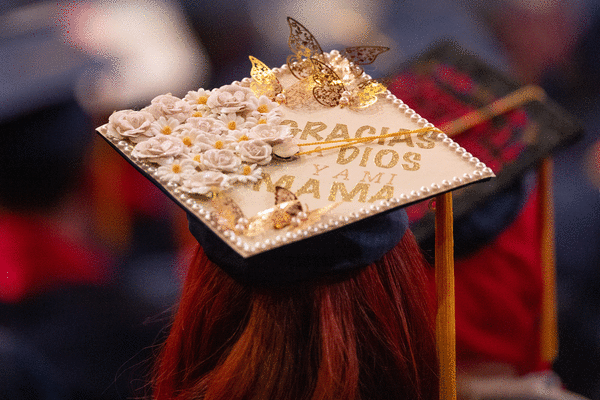
At this time of year, family calendars implode under the weight of school performances, sports tournaments, award ceremonies, teacher gifts, graduation traditions, summer camp forms and holiday travel plans. How to deal with it all?
Moms often get a piece of well-intentioned advice: Just trust your instincts. Follow your heart. Tune into how you feel.
Here is a different message: It’s OK to not listen to your feelings.
I’m a mom, and I know how incredibly hard this is to hear. In the overload of Facebook mom chats, WhatsApp school parent group messages, Substack posts, and viral celebrity toxic mom group drama, every parenting decision I make feels morally and developmentally consequential for my child. I’m exhausted, like so many other moms, not only because I am doing so much physical, mental and emotional caregiving labor. But also because an inner voice is convincing me that I must feel everything, be in control of everything and listen to my instincts to sift through the overload.
“Listening to my gut” doesn’t give me the answers. Instead of bringing more clarity, it amplifies anxiety. My gut, it turns out, runs on a loop of second-guessing, self-monitoring and low-grade dread. What I feel in my gut is how every issue needs solving, every pang of guilt requires correction and anything I may decide to forgo to abide by “do less” advice may be something truly consequential for my child’s future.
This is not just my obsessive personality. It’s part of modern emotional parenting culture.
Over the past decades, a quiet cultural shift has redefined the standards of modern parenting. It is no longer enough to keep children safe, fed and loved. Today’s mothers are expected to be both hyperrational project managers — scheduling enrichment, monitoring nutrition, tracking developmental milestones — and deeply intuitive caregivers, continuously consulting their emotional compass for guidance about their children and themselves. Sociological research consistently finds that mothers, far more than fathers, do this interior work of parenting.
One teacher and mother of two, whom my research team talked to recently, captured this when we asked her what being a parent meant to her. “There’s a part of me,” she said, “that I think about constantly even if it’s in the back of my head … that I’m responsible for and that I love in a way I could never really articulate.” That love is real and fierce but also draining when our culture insists that it must translate into constant emotional engagement.
We take expectations of emotional attunement for granted. They are part of a broader cultural shift toward emotionalization of life that has been ongoing since at least the 1980s. Therapeutic culture exploded, and media like “The Oprah Winfrey Show’ made emotional guidance into prime-time entertainment. In “The Sopranos,” we saw even a mafia boss consulting a therapist to deal with family and “Family” problems. We live in a culture that has made emotions increasingly central to our lives, where we are feeding on vibes, are driven by hype and vibecession or have FOMO or go delulu.
Mothers not only seek expert opinion on parenting but tune into emotionally evocative stories about motherhood that make feelings a source of moral authority. Social media and momfluencers have turbocharged this. The result is a relentless flood of advice that derives its authority not from expertise but from personal testimony, endlessly reinforcing the idea that your feelings are your most important parenting instrument. Mothers today need to do emotion work to support their children, but they also need to worry about their children’s emotional well-being and be preoccupied with their own emotional identity of what it means to be a good mother.
Emotion upon emotion upon emotion — and we are told to listen to all of it.
Many will say that emotionally engaged parenting is simply what children need and that decades of research in developmental psychology confirm the value of attentiveness, warmth and responsiveness. That’s all real. Studies show that children fare better as adults when their parents are present and attuned. Also, concerns of declining mental health of children are real, and challenges of supporting children with special needs are being amplified with removal of social safety net supports. No one here is arguing for emotional indifference.
Yet, there is a meaningful difference between being emotionally available and being emotionally exhausted, between emotional support and emotional overinvestment. The problem is not that mothers love their children too deeply. It is that our culture has persuaded them that love without constant emotional vigilance is insufficient. That every unexamined feeling is a parenting failure waiting to happen. That moms not only should worry about their children, but they must worry even more about being the perfect mom.
These new social norms of overinvested parenting are leading to parental burnout at a point in which nearly 1 in 2 say that parenting stress is completely overwhelming. That is not sustainable.
Mothers do not need more advice to make them feel good. They need a clearer understanding that letting a worry pass without acting on it may be helpful rather than harmful. That it is OK to have feelings and not listen to all of them. To let a child grapple with challenges of growing up without rushing to the rescue or snowplowing problems before they even occur. To not feel like the weight of a million decisions that will determine their child’s life is on their own shoulders, when research shows that parenting is less consequential for child outcomes than how much we believe it is.
Less emotional engagement does not mean less care. But it may mean prioritizing kid activities that are not chosen because we want to keep up with the Joneses, less micromanagement of schoolwork and preoccupation with cultivating resumes, more tolerance for the messiness of family life. It may mean recognizing that a multibillion-dollar parenting industry profits from keeping mothers supremely emotionally vigilant (read: super anxious). It may mean resisting that pressure together rather than absorbing it alone.
Mom, you are not failing your children by not listening to all your feelings. You may, in fact, be giving them something increasingly rare: the chance to grow up a little more on their own terms. You may give them the chance to watch their mother not feel all the feels but sleep better at night, have more energy and a greater peace of mind. Chances are that would actually feel great.
____
Nina Bandelj is chancellor’s professor of sociology at the University of California Irvine and author of “Overinvested: The Emotional Economy of Modern Parenting.”
_____
©2026 Chicago Tribune. Visit at chicagotribune.com. Distributed by Tribune Content Agency, LLC.










































Comments